
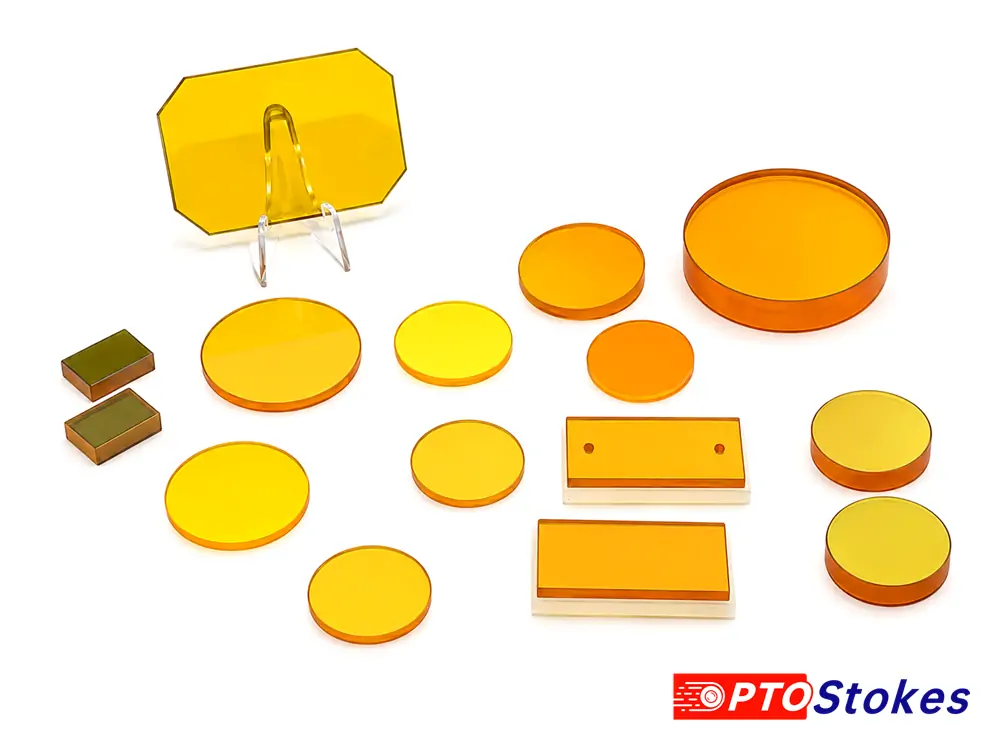
Magnesium Fluoride (MgF2)
Magnesium Fluoride (MgF2) optical material for UV to IR use, with ordinary and extraordinary refractive-index references for engineering review.
Key Properties
Primary engineering references for material screening, packaging review, and RFQ preparation.
About Magnesium Fluoride (MgF2)
Overview
Magnesium Fluoride (MgF2) is often selected when broad spectral coverage, low refractive index, and birefringent behavior must all be considered in the same design review. For practical engineering use, the ordinary and extraordinary rays should be treated separately whenever polarization or crystal orientation matters.
Key Material Reference
| Parameter | Reference |
|---|---|
| Practical Transmission Guidance | 0.12-9.0 µm |
| Local RII Dataset Range | 0.14-7.5 µm |
| Reference Dataset | Li formula 1, 293 K, ordinary and extraordinary rays |
| Refractive Index | no=1.3785 / ne=1.3903 at 0.55 µm |
| Density | 3.177 g/cm3 |
| Knoop Hardness | 415 kg/mm2 |
| Young's Modulus | 138.5 GPa |
| Thermal Expansion | 13.7 parallel c / 8.9 perpendicular c x 10^-6 /K @373 K |
Selected Refractive Index Reference
The values below are practical references from the local RII dataset at 293 K. Final crystal orientation and polarization-sensitive designs should always use the confirmed ray path and optic axis requirement.
| Wavelength (µm) | Ordinary no | Extraordinary ne |
|---|---|---|
| 0.200 | 1.4232 | 1.4368 |
| 0.300 | 1.3931 | 1.4056 |
| 0.550 | 1.3785 | 1.3903 |
| 1.000 | 1.3737 | 1.3853 |
| 3.000 | 1.3619 | 1.3725 |
| 5.000 | 1.3401 | 1.3488 |
Typical Applications
- UV windows and protective optics
- Broadband windows for laboratory systems
- Birefringent and polarization-sensitive optics
- Laser optics and alignment components
Engineering Notes
MgF2 should not be treated as an isotropic drop-in material when crystal orientation matters. Engineers should confirm ray direction, polarization sensitivity, coating target, and use environment before releasing the drawing. Compare other candidate substrates through the materials index and the available manufacturing routes under products if the design might also fit CaF2 or LiF.
Procurement Checklist
- State whether the optic is orientation-sensitive or whether birefringence is not critical for the application.
- Include wavelength band, dimensions, quantity, and coating target in the RFQ.
- Call out any UV durability, laser use, or environmental requirement that changes inspection scope.
- Confirm whether the request is for a substrate blank, finished window, or design-for-manufacture review.
Request Engineering Review
Send wavelength band, dimensions, quantity, coating target, and orientation notes through the contact page for a practical MgF2 review.